
Rumpole
John Mortimer's immortal barrister

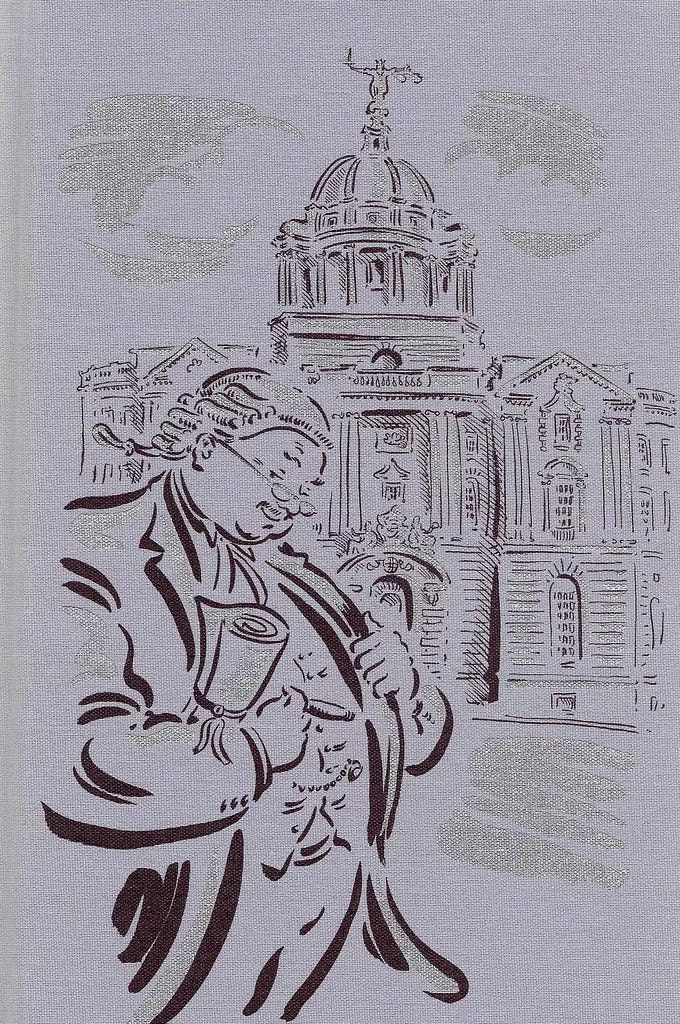
After Mayhew’s catalogue of London characters and crooks last time, I’m staying with London and crime for this week’s First Folio. It’s a selection of John Mortimer’s short stories featuring his beloved character, the barrister Horace Rumpole.
John Mortimer was himself a barrister as well as a novelist and screenwriter. His father, also a barrister, was suddenly struck blind in an accident, but continued to practise. He is remembered in Mortimer’s A Voyage Around My Father, played in the West End by Alec Guiness, and on film by Laurence Olivier. Rumpole is at least partly based on him. The character was originally conceived for a television play, whose success led to a series. Mortimer says in his introduction that he wanted a detective character like Maigret or Sherlock Holmes to sustain him in his old age. Mortimer recalls the genesis in his introduction to the Folio edition.
So, when I looked for a character to be my detective I found him very near at hand. I thought of all the old defenders in criminal trials I had known - rumpled, untidy men, fond of claret and steak and kidney pie, who often called the most unattractive judges and the most hardened bank robbers ‘old darling’ but never called their wives ‘old darling’. I thought of my father, who was also a barrister, and his costume which was rather like that which Mr Churchill used to wear in the war: a black jacket and waistcoat across which stretched a gold watch-chain, often smothered in cigar ash, a stand-up collar and a bow-tie. My father also had Rumpole’s habit of quoting poetry at very inapposite moments. When I was about four when he saw me he would say, ‘Is execution done on Cawdor?’ which, when you’re four, is a pretty tough question to have to answer. Barristers are meant to be polite to solicitors, who bring them work, but when he was displeased with one of them my father often said, ‘The devil damn thee black, thou cream-faced loon’ thinking they’d be glad of another quotation from Macbeth.
Other barristers have been suggested for the ur-Rumpole. This obituary of Lord Hutinchson of Lullington suggests very firmly that he was the inspiration. Another barrister, James Burge, famous for his work on the Profumo case, has also been identified as the original of the character. Indeed, according to Mortimer’s obituary in the Daily Telegraph:
In the early 1970s Mortimer was appearing for some football hooligans when James Burge, with whom he was sharing the defence, told him: “I’m really an anarchist at heart, but I don’t think even my darling old Prince Peter Kropotkin would have approved of this lot.” “And there,” Mortimer realised, “I had Rumpole.”
This seems to be a reference to the first incarnation of Rumpole, in the television play originally entitled “My Darling Prince Peter Kropotkin”, which was to feature a barrister called Horace Rumbold, who was a secret anarchist. The name was subtly changed when it was discovered there was a real barrister of that name. The play was eventually broadcast as Rumpole of the Bailey. It starred Leo McKern as Rumpole, an actor who I first encountered as Number Two in Patrick McGoohan’s cult show The Prisoner.

McKern had played Thomas Cromwell in the acclaimed 1966 film A Man For All Seasons, and had even appeared in the Beatles film Help! as well as stints in the Royal Shakespeare and Old Vic companies. In McKern, Mortimer found the perfect Rumpole, and Paul Cox’s illustrations are quite clearly representations of McKern in the rôle. Mortimer had, however, envisaged Alistair Sim as the lead, but
…Mr Sim was dead and unable to take on the part. In a happy moment Leo McKern was approached and in an even happier moment he agreed to play the role. He is a superb actor of endless invention and instinctive taste. He brought Rumpole wholly and wonderfully to life, and it would now be impossible to think of anyone else playing the part.
The stories are prose versions of the scripts for the television series. Rather marvellously, it seems that all, or virtually all of the TV versions are available on YouTube, beginning with that first Play for Today. In the series, Mortimer used voice-overs by Rumpole, and the opening of the first story in the Folio edition is a kind of written voiceover, providing a quick overview of the character, and swiftly establishing the tone of the stories:
I, Horace Rumpole, barrister at law, sixty-eight next birthday. Old Bailey hack, husband to Mrs Hilda Rumpole (known to me only as She Who Must Be Obeyed) and father to Nicholas Rumpole (lecturer in social studies at the University of Baltimore, I have always been extremely proud of Nick); I, who have a mind full of old murders, legal anecdotes and memorable fragments of the Oxford Book of English Verse (Sir Arthur Quiller-Couch’s edition) together with a dependable knowledge of bloodstains, blood groups, fingerprints, and forgery by typewriter; I, who am now the oldest member of my Chambers, take up my pen at this advanced age during a lull in business (there’s not much crime about - all the best villains seem to be off on holiday in the Costa Brava), in order to write my reconstructions of some of my recent triumphs (including a number of recent disasters) in the Courts of Law, hoping thereby to turn a bob or two which won’t be immediately grabbed by the taxman, or my clerk Henry, or by She Who Must Be Obeyed, and perhaps give some sort of entertainment to those who, like myself, have found in British justice a life-long subject of harmless fun.
That introduction pretty much sets the tone for the entire oeuvre, which is more extensive than I had thought. Rumpole, like Sherlock Holmes, attracts obsessives, and one fan has listed every appearance in print, TV and radio here. The Folio selection, by the author, is meant to show the range of Rumpole’s cases. They all, of course, revolve around Rumpole for the defence at the Old Bailey, but Mortimer shrewdly varies the circumstances and the milieu, managing to present a broad portrait of Britain in the seventies and eighties. Mortimer continued to write Rumpole stories until 2007, two years before his death. This Folio selection, though, might be said to be the classic Rumpole.
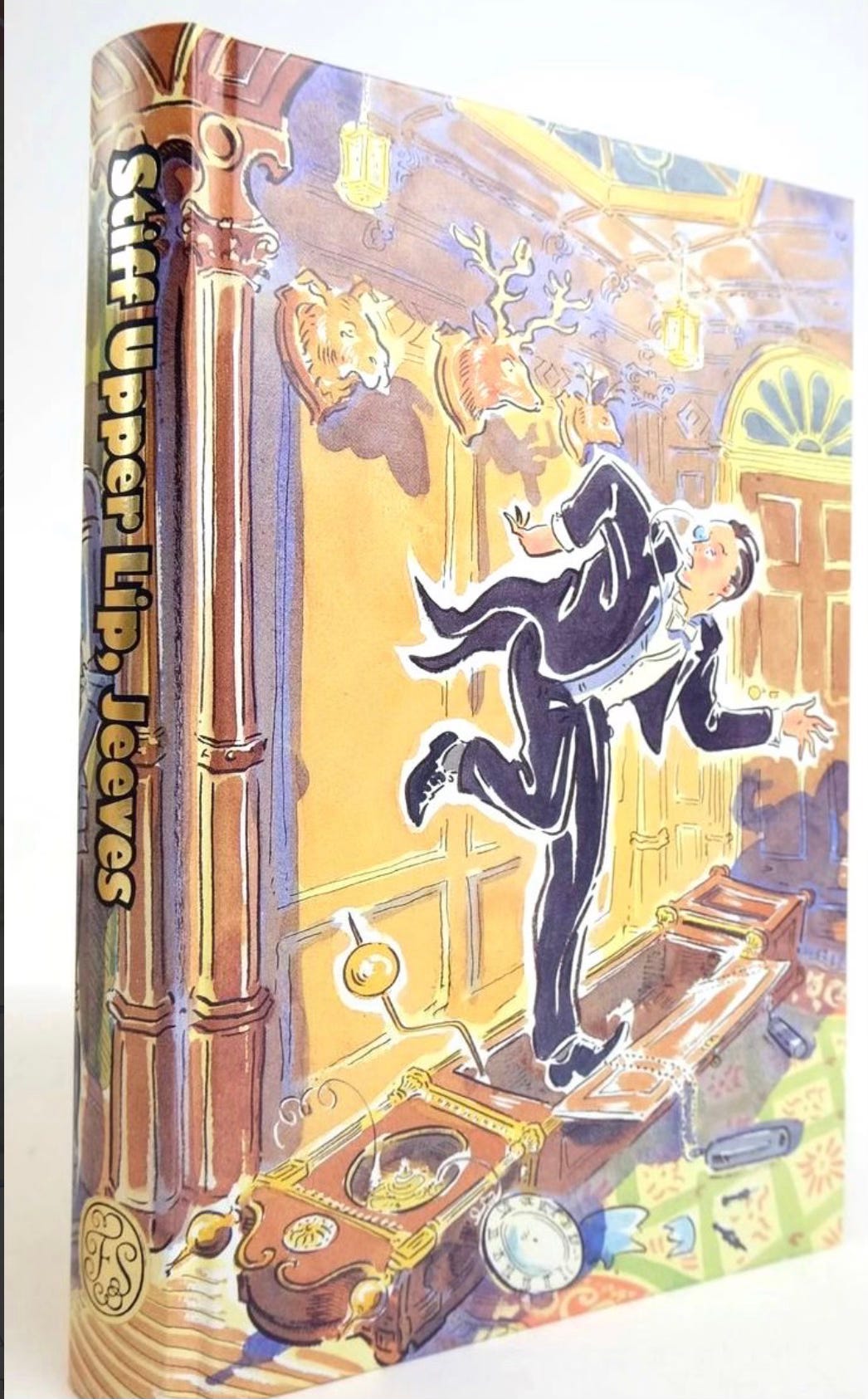
The book is undeniably enhanced by the presence of the delightful illustrations by Paul Cox, whose Instagram account offers a collection of his distinctive images. In this Rumpole volume, as well as full-page and double-page spread illustrations, there are many little vignettes, making this one of the most heavily decorated Folios in the collection. Cox is an ideal artist for this commission. His distinctive style is warm and whimsical, and the only downside to his work here is that there is none of his usual vibrant colour. All the paintings are black-and-white. Some of the colourful style Cox brought to his illustrations for PG Wodehouse stories, also in Folio, would have been welcome here. Here is one of Cox’s cover illustrations for the Folio Wodehouse.
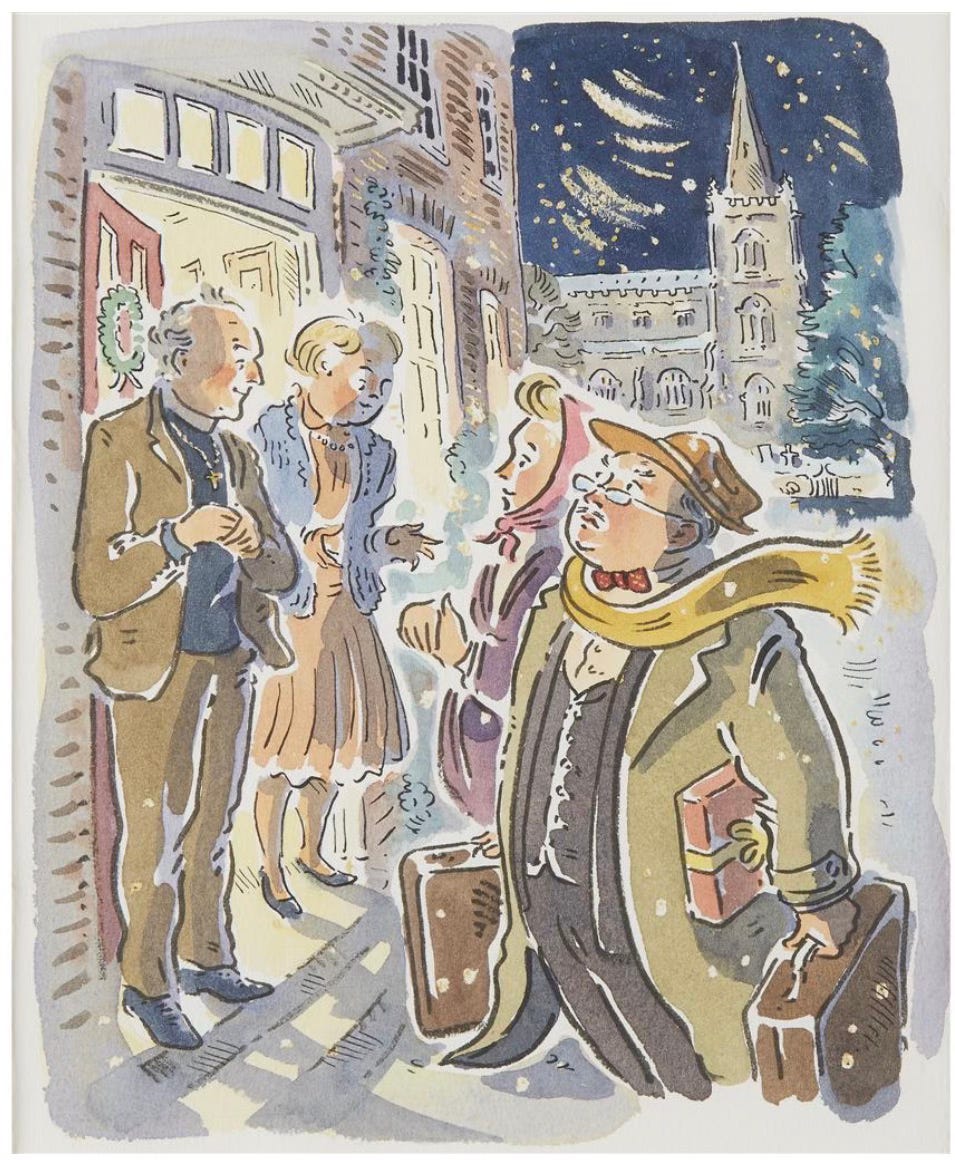
Evidently, Cox did make at least one colour illustration featuring Rumpole. This image, “Rumpole’s Christmas Party” pops up as an item sold at auction. I don’t know if this ever featured in a Rumpole book. There is a very late collection of stories, Rumpole at Christmas, which has a cover illustration by Tony Healey. The US version of this book, entitled A Rumpole Christmas, has a cover illustration by yet another artist.
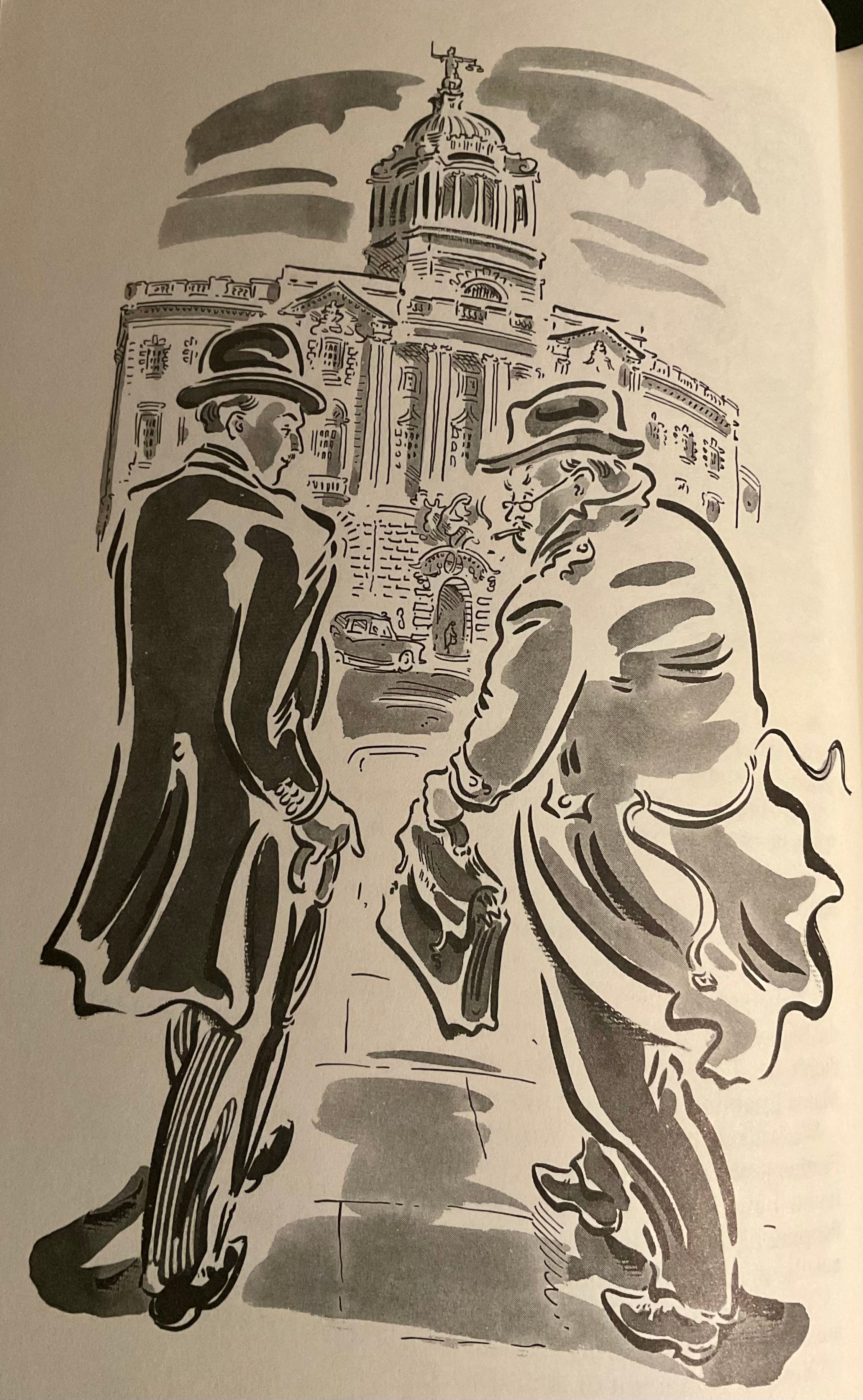
Despite their monochromicity (is that a word?) these line and wash pictures are a delight. Cox’s fluid, lively method seems ideally suited to these very British stories. Here is Rumpole on his way to the Old Bailey in the first story.
And here is Rumpole in his natural habitat, an Old Bailey court room in a double page spread:
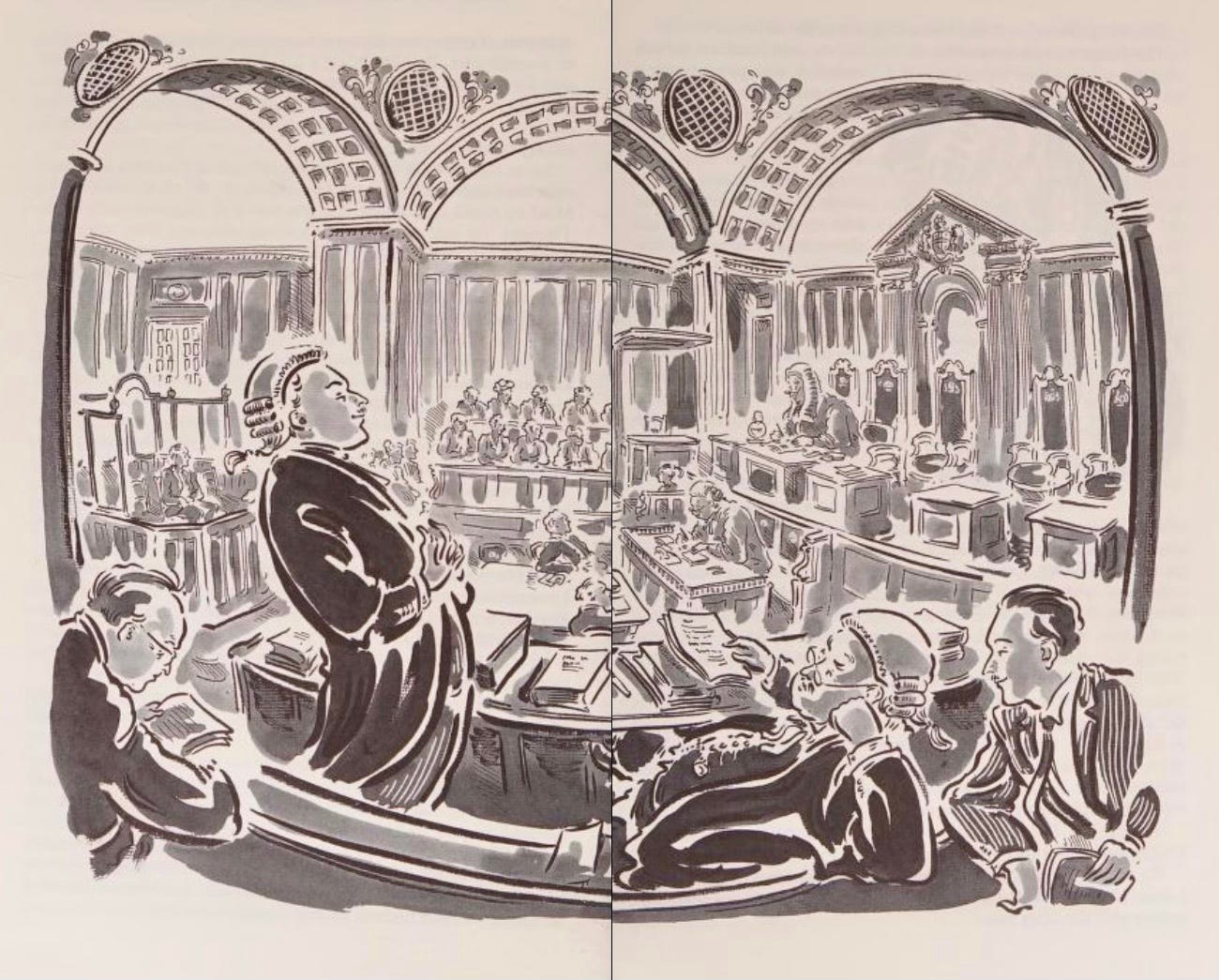
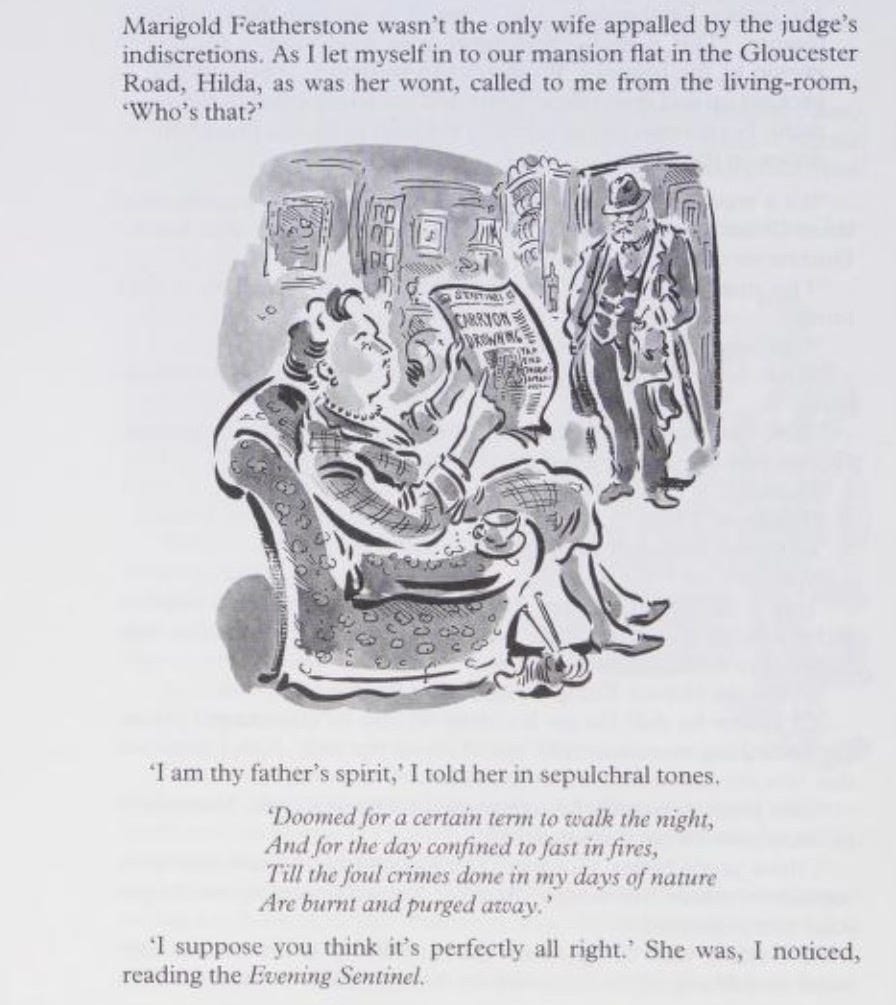
These full-page and double-page images are complemented by smaller paintings which appear in profusion throughout the text. These are close interpretations of the action of the stories, and work brilliantly alongside Mortimer’s prose.
I notice that Rumpole has now appeared as a Penguin Modern Classic, which is, I suppose, the ultimate accolade for a twenty-first century work of fiction. They have gone with one of the classic HM Bateman cartoons for the cover, which I can’t help but feel is a missed opportunity.
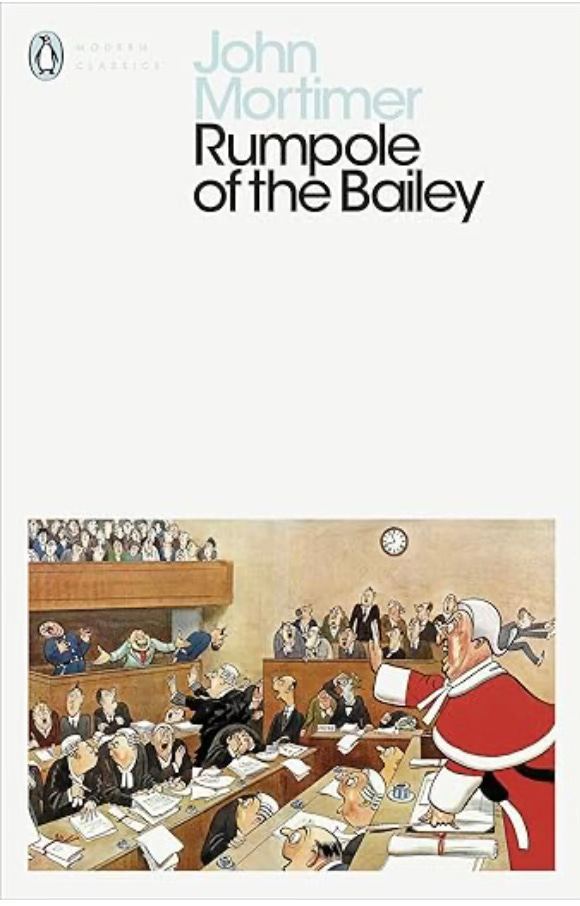
Bateman’s heyday was in the 1920s, and he died well before the time in which the Rumpole stories are set. They could have asked Paul Cox….
John Mortimer, Rumpole, selected and introduced by the author. Illustrations by Paul Cox. Folio Society, 1994. Printed on Hamilton Wove paper at The Bath Press, Avon. Bound at The Bach Press in full cloth printed and blocked with a design by the artist