
The Leopard
Decay and decline in nineteenth century Sicily

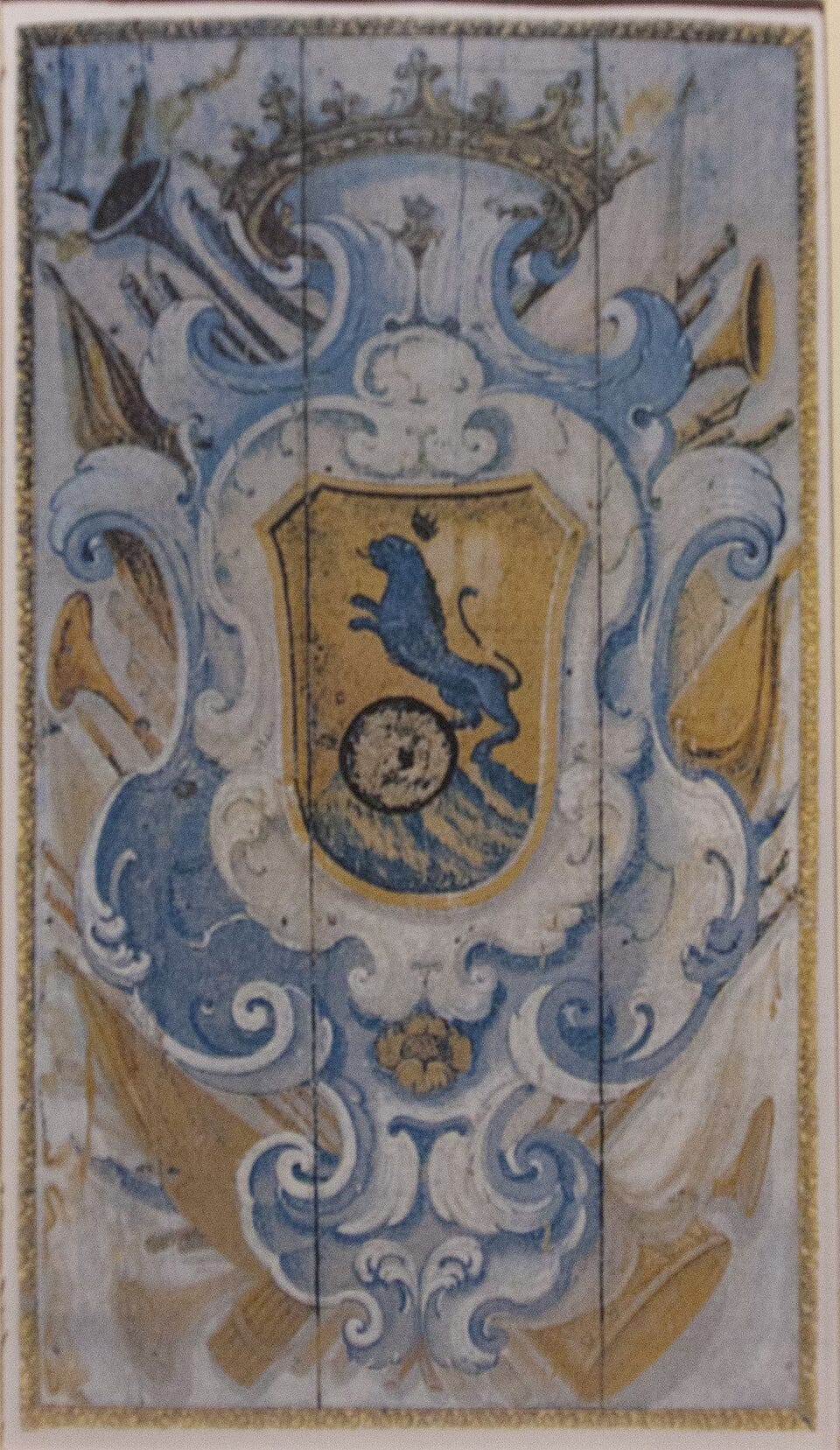
This sequence of Folio books with an Italian connection continues with Giuseppe di Lampedusa’s posthumously published 1958 historical novel Il Gattopardo, or in English The Leopard. (Interestingly, a more strictly literal translation of the title would be The Ocelot, or African serval, because that is the creature that features on Don Fabrizio’s coat of arms.) I suspect most non-Italians will be more familiar with the film made in 1963 by Visconti, with Burt Lancaster improbably cast as Don Fabrizio.
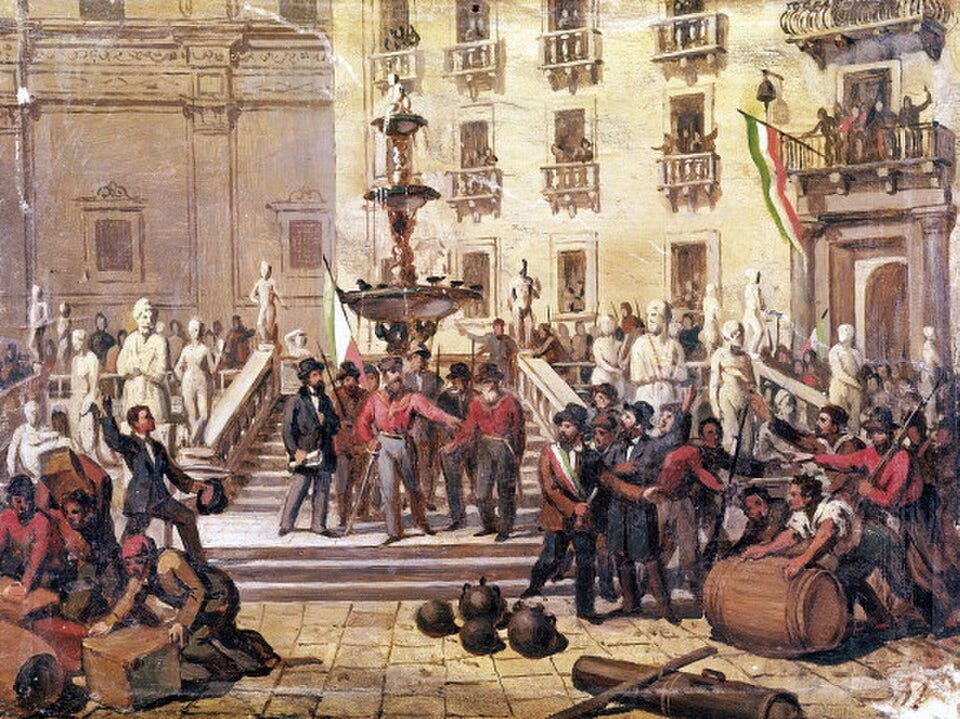
The novel takes place against the dramatic backdrop of the 1860 Risorgimento, when Garibaldi landed in Sicily to wrest control from the Bourbon dynasty in his struggle to unite Italy. To digress a little here, I recently read and enjoyed Tim Parks’s account of a walk following Garibaldi’s route as he retreated from Rome in 1849. Now I see he has followed that up with a book retracing Garibaldi’s Sicilian march in 1860. As he says, “Inevitably the book becomes a meditation on the relation between past and present, the Italy that the Risorgimento volunteers dreamed of and the Italy we have today.” And that exploration of past versus present is very much to the fore in The Leopard. Don Fabrizio stands as a representative of the old order which is in the process of being swept aside by Garibaldi and his revolutionaries. When the book was published in 1958, the fact that the recently deceased author was a Sicilian nobleman together with the subject matter, led to some strong condemnation. The book was characterised as a reactionary and elitist by its critics. Nevertheless, it became a huge popular success, and rapidly established itself as a classic.
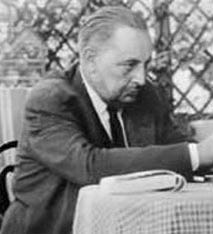
The author, Giuseppe di Lampedusa, spent his early life in the family home, the Palazzo Lampedusa in Palermo. The palazzo was destroyed by Allied bombing in the war, and the family later moved to a more modest villa. Lampedusa was by all accounts a rather solitary man, somewhat of an autodidact, and although he married a Latvian psychoanalyst, they spent much of their time apart. The Leopard is his only novel, and it, together with some literary-critical sketches and some short stories, constitutes his entire oeuvre. The novel was rejected many times before eventually being taken up, albeit after the author’s death.
The novel captures the decline of Sicily’s aristocracy as Garibaldi and his thousand volunteers land with the objective of unifying the Kingdom of Naples, of which Sicily was a part, with the Italian peninsula under King Victor Emmanuel II. Don Fabrizio, like the author, an aristocrat with a princely title, naturally opposes the revolutionaries, but his favourite nephew, Tancredi, declares his support. Tancredi, rather selfishly ambitious, falls for Angelica, the daughter of a prosperous merchant, who represents the coming change in the state. Don Fabrizio needs to decide whether to bless the union, thus implicitly endorsing the new dispensation, or to remain true to tradition, and accept his own increasing irrelevance - and, incidentally, disappoint his daughter, who has set her heart on Tancredi. The novel pits past and present, tradition and innovation against each other, against the opulent background of the fading baroque environment of feudal Sicily.
The Folio edition is introduced by Raleigh Trevelyan, himself a kind of relic of an older tradition. His name proclaims his Cornish ancestry, and his connection to Walter Raleigh, a distant ancestor, whose biography he wrote. Trevelyan was a child of the British Raj, born in the Andaman Islands where his father was a prison administrator. The family had for generations been established in India, and the young Raleigh moved with his parents to Punjab and then Kashmir, before, inevitably, being sent back to public school in England. After war service, including in Italy, he became an editor and writer. Several of his works are on Italian subjects, including Princes Under the Volcano: Two Hundred Years of a British Dynasty in Sicily. He was thus an ideal choice to introduce this novel. The introduction, though, is quite unusual, in that it details not just the scope and history of the novel, but also his rather poignant visit to the author’s widow in 1967:
In the year before the earthquake I called on the Princess of Lampedusa in the house in Via Butera. Children and chickens scattered as l entered the courtyard. A tug at an outside bell revealed an ancient, almost doddering servant, who led me up the still grand staircase. It was an afternoon of great heat, so the shutters were drawn. The salone was lit by candles, which did not make the room any cooler. The princess was all in black, with a black bandeau low on her forehead. she offered me vodka and chocolates, and spoke with an accent that was unmistakably northern European. We talked a little about her own work as a practising Freudian analyst. Patiently she reiterated the story of her husband’s typescript doing the round of publishers. She regretted the disappearance of Palermo’s palaces. Only the Palazzo Gangi had really survived, and it was in the ballroom there that the scene in Visconti’s film had been shot. She did not like the impression that she felt had grown up abroad of her husband mixing solely with nobles and moving in drawing-rooms of the ‘twirling pearls’ set. She reiterated that he was a very modest quiet man. His best friend was a pastor’s son on the Swiss border in northern Italy.
The earthquake to which Trevelyan refers is the one which occurred in 1968. A member of the Whitaker family, Anglo-Sicilian aristocrats, who feature in Trevelyan’s book Princes Under the Volcano, reported on the impact:
In 1968 an earthquake shook western Sicily, and there was enormous damage in and around Santa Margherita Belice. One of the Whitaker family went to help in relief work. “Palazzo Cutò,”he wrote, “has crumbled inside, the tower with the clock has tallen and destroyed the balcony. The façade is ruined and there is no hope of saving it. The courtyards are full of rubble, and in the second courtyard one can see the green marble staircase rising out of the rubble. We picked up a piece of that belled cross of the Cutò arms that Lampedusa describes in Places of My Infancy. The trees are still there in the garden, and you can get in as you please because the walls are down. Some of the statues have already been stolen. Nearby we could see a tailor’s shop; on the first floor suits were still hanging and a cat was calling for help. Palazzo Lampedusa in Palermo is gone, and now “Donnafugata” has gone too. It is like a new last chapter in The Leopard. It would have broken Giuseppe di Lampedusa’s heart.”
Donnafugata is the name of Don Fabrizio’s estate.
The translator here is Archibald Colquhoun, who, like Trevelyan also had strong ties to Italy, having been director of the British Institute in Naples before the war. He was responsible for some of the first translations into English of Italo Calvino, but The Leopard was probably his greatest hit.
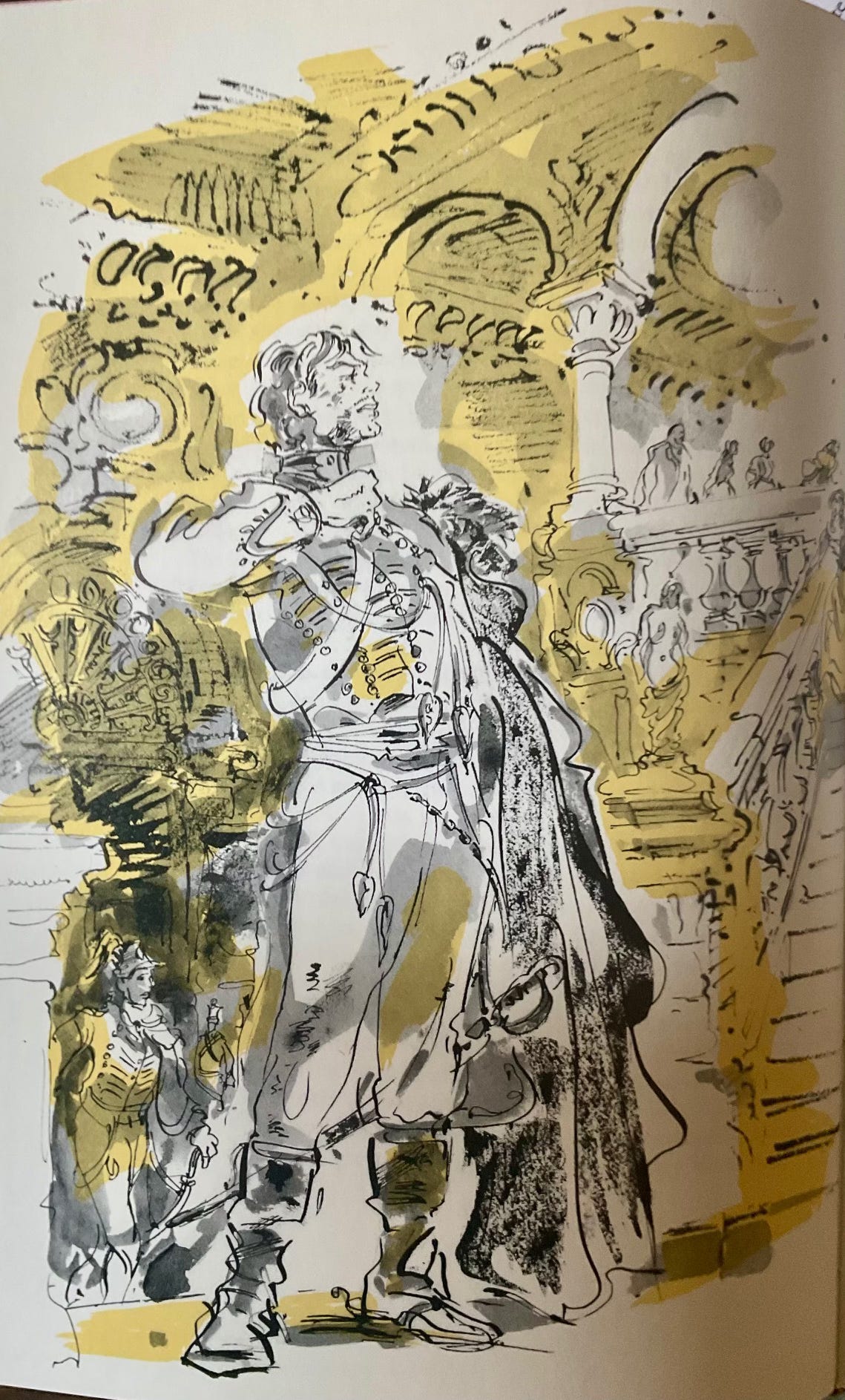
Folio’s illustrator here is Ian Ribbons, whose delicate drawings render the faded grandeur of nineteenth-century Sicily very evocatively. The book has lots of small vignettes as well as really striking full page and double page images. The famous ball scene, given twenty-five minutes of screen time in Visconti’s film, is rendered particularly impressively.
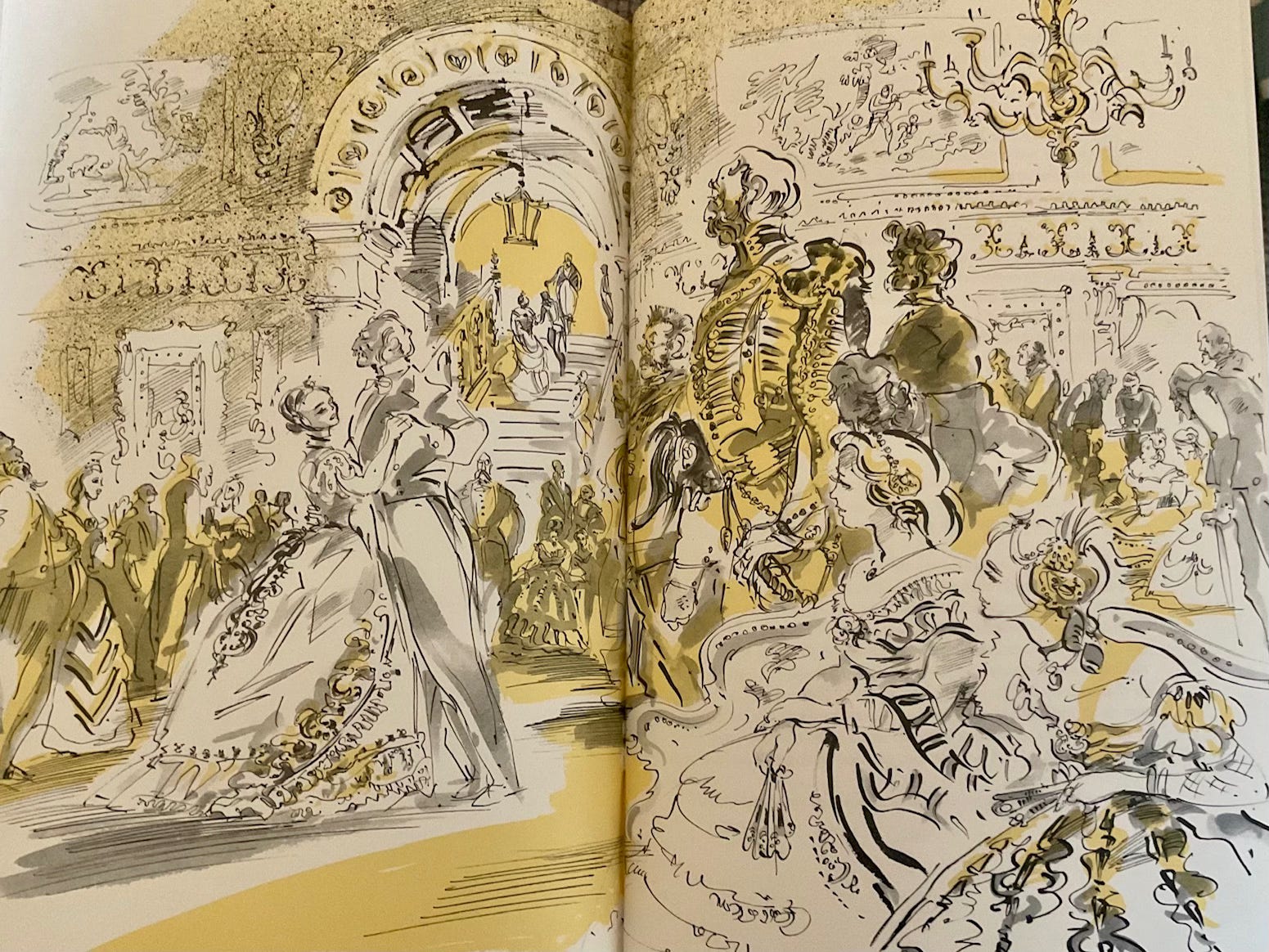
Ribbons was a well-regarded artist, whose work appeared in many magazines and books. In the Folio magazine for Autumn 1988, he recounts the trip he made to Sicily with his Italian wife to work on the drawings for this edition of the book. A chance encounter with an old student friend of his wife leads to a meeting with Giuseppe Tomasi di Lampedusa, “the current prince,” who offers to show Ribbons around the book’s locations. Having been chased off the grounds of the Villa Falconeri, where the fictional Tancredi lived, by a stern custodian, they venture to the Lampedusa estate, the model for Salina in the novel.
The Villa Lampedusa is now a pathetic half-ruin. No guardian in black, but suspicious dogs follow us up a rough drive and inside the courtyard bark their heads off in defence of a friendly countryman revealed milking cows in an outhouse. The place seems leased as a kind of small-holding. We step warily inside: dust, broken floorboards, everything surprisingly small-scale. The Prince tells me he played here as a boy. From the balcony one can indeed see down the valley, partly built up now, and flatter than I’d imagined, all the way to Mount Pellegrino and the sea.
I was a bit puzzled by Ribbons’s reference to his guide as the current prince, since the line ended with the author. I think maybe he met Gioacchino Lanza Tomasi, a distant cousin of the author, whom Lampedusa adopted as his son. He carried the old title as a courtesy, and occupied the author’s former home in Palermo. Gioacchino died in 2023, aged 89 after a very distinguished international career as a music critic and director of various cultural institutions. It was he who discovered some extra material for The Leopard, which he incorporated in his edition of the book, published in 2007, and which, I see, now has a TV tie-in cover for the Netflix series. The family home in Palermo is now a rather glamorous holiday let, as detailed in this Times article.
These sad remnants of something previously noble that Ian Ribbons witnessed are reflections of the novel’s theme of the clash between inertia and the impulse for change. As Tancredi says, “if we want things to stay as they are, things will have to change.” But he sees the change as advantageous to himself in his ambition for a diplomatic career. So the line, still used as a political slogan in Italy, is ambiguous at best. More pertinent is perhaps the reaction of the world-weary Don Fabrizio to Chevalley, who has been sent to offer him a place in the new senate. He refuses, saying
We are old, Chevalley, very old. For over twenty-five centuries we’ve been bearing the weight of superb and heterogeneous civilisations, all from the outside, none made by ourselves, none that we could call our own. We’re as white as you are, Chevalley, and as the Queen of England; and yet for two thousand five hundred years we’ve been a colony. I don’t say that in complaint; it’s our fault. But even so we’re worn out and exhausted.
Of course, Sicily’s history is one of recurring invasion, colonisation and conquest, going back millennia to the ancient Greeks and Phonecians, to the Roman empire, the Byzantine and Islamic periods, the Viking and Norman reigns, and then the Spanish kings, the House of Savoy, the Austrian Habsburgs and the Spanish Bourbons, who were overthrown in 1848, but regained power shortly after. So this long and complex history is being evoked by Don Fabrizio, and implicitly by Lampedusa too, both of them at the end of their lives feeling a sense of impending obsolescence.
The Leopard caused controversy when it was first published, but was so popular it was reprinted 52 times in the first six months. Left wing critics felt it was too conservative, whilst right wingers attacked its portrayal of the upper class. In truth, Lampedusa is excoriating about all classes of Italian society, attacking the hypocrisy of aristocrats and bourgeoisie alike. It resonates still in its portrayal of human failings. As E.M. Forster said, “Reading and rereading it has made me realise how many ways there are of being alive.”
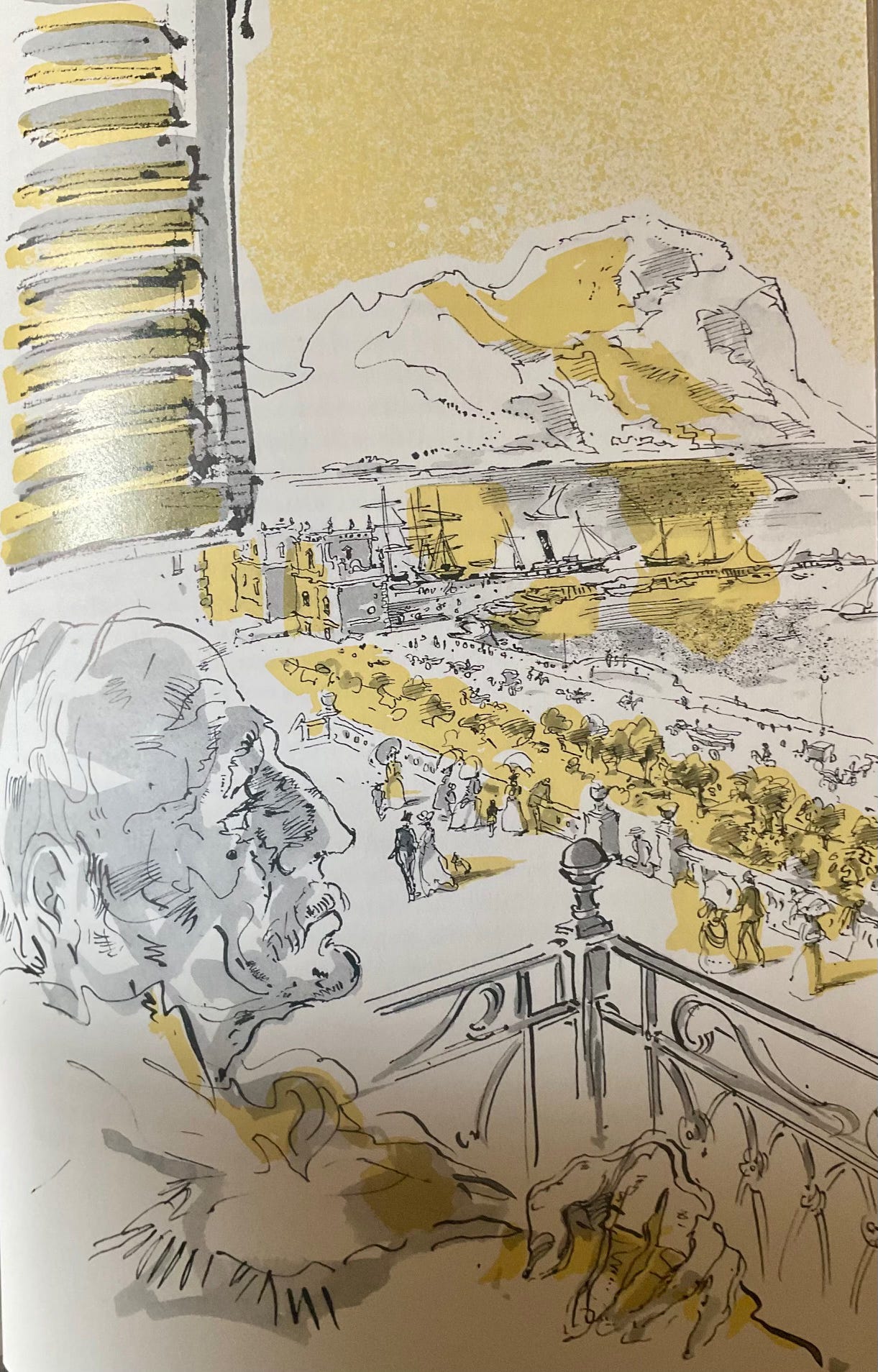
Giuseppe di Lampedusa, The Leopard, trans. Archibald Colquhoun, introduced by Raleigh Trevelyan, with drawings by Ian Ribbons, Folio Society, 1988.
Set in Monotype Bembo with Old Face Open Display by Speedspools, Edinburgh.
Printed at the Bath Press, Avon on R.H. Antique Wove paper. Bound at the Bath Press, with Italian paper sides.
What will forever stick with me is Concetta, losing her shot with Tancredi because she can't bring herself to laugh about a rape joke. Very relatable!
That said, I think she was always going to lose against Angelica - that chemistry was undeninable (that chapter about the lovers exploring the palace!), even if it predictably fizzles out rather sooner than later. Some passions are meant to fizzle after a burst, and some to slowly fade in a strange dignity, and who's to say what's the sader fate? If you're meant to fade, you probably don't have that burst in you to fizzle; and if you're meant to fizzle, you might not have the dignity to fade. Maybe the most we can hope for is the decline that suits us.
My goodness, a lovely piece on a novel that deserves its place in the first rank of European novels.